The emergence of Artificial Intelligence (AI) in society has been one of the most significant technological advances of recent decades, with a cross-cutting impact on sectors such as the audiovisual and creative industries. In this context, Generative Artificial Intelligence (GAI) is emerging as a key element in the transformation of technical and creative processes, by enabling the generation of original content using machine learning models.
This major technological revolution has paved the way for the democratisation of AI-assisted tools, namely Generative Artificial Intelligence (GAI). Various scientific articles define GAI as a set of machine learning-based models capable of generating original content from human instructions, known as prompts. These systems combine data acquired during their training with the semantic interpretation of the user’s instructions, generating content based on their knowledge and human interaction.
This scenario presents new opportunities for the creative sector, such as process optimisation and the development of new professional skills, using AI-powered tools. In the audiovisual sector, it also opens up new horizons in narrative planning at the sequence level, in content production and post-production, in the distribution of audiovisual products, and in copyright management.
Applications of GAI in audiovisual production
The implementation of AI in the audiovisual sector is becoming increasingly prevalent across multiple stages of the technical and creative process. In the early stages, its use facilitates the generation of ideas and narrative structuring, allowing for the exploration of multiple approaches in a flexible and efficient manner. In production and post-production, GAI is used with editing tools that automate tasks such as image stabilisation, sound enhancement, the generation of visual effects, and automated dubbing. These applications, notably Adobe Suite software with AI integrated into its interface, help to optimise resources, streamline processes, and expand the medium’s expressive possibilities.
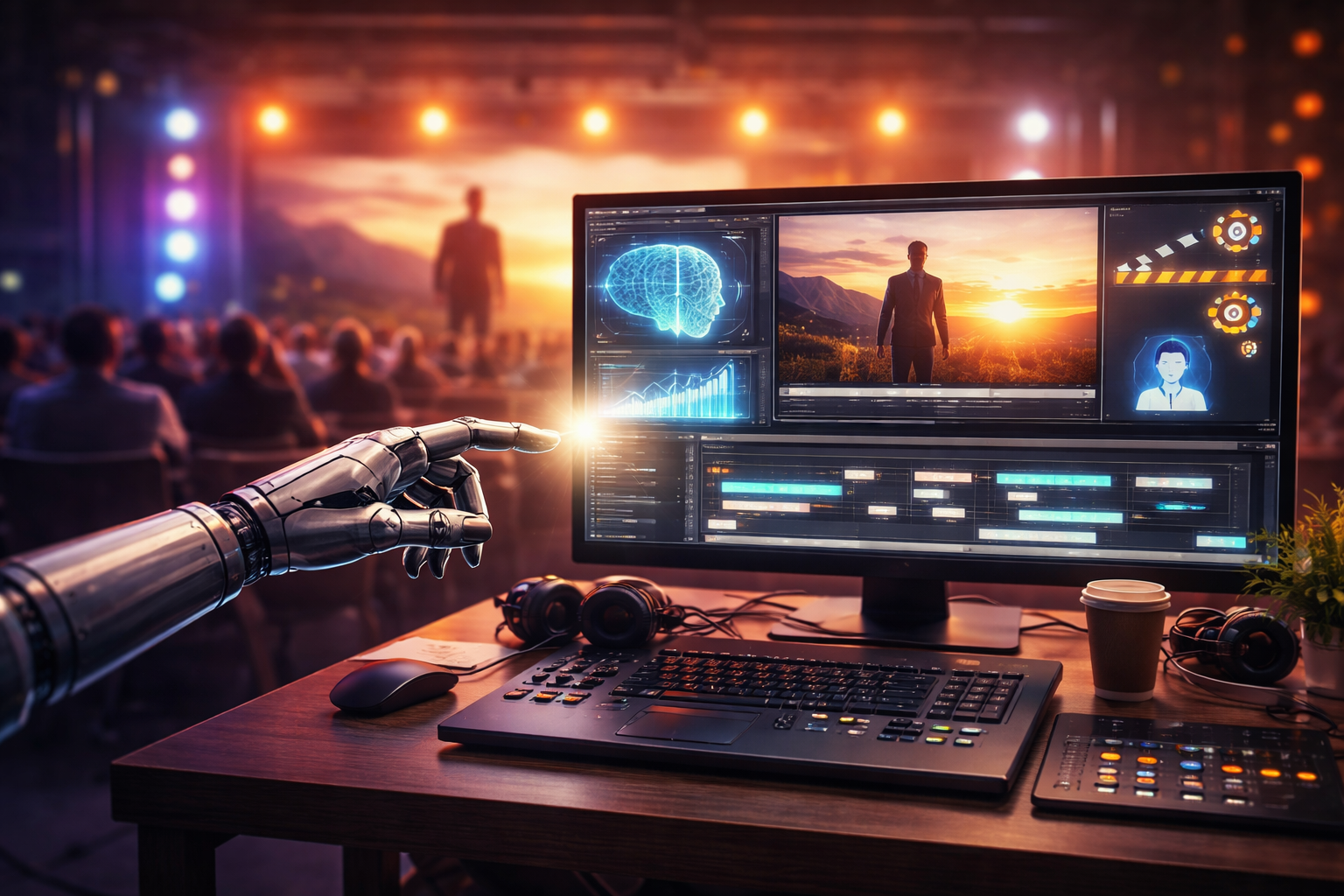
In this way, AI not only serves as a technical resource, but also has a direct impact on redefining creative processes, fostering new forms of interaction between technology and audiovisual storytelling.
The Málaga Festival: a forum for reflection and innovation in the age of AI
Now in its 29th year, the Málaga Film Festival has reinforced its role as a forum for reflection and analysis on the integration of AI into the film industry, establishing itself as a strategic platform for examining the impact of emerging technology on the Latin American creative sector.
Initiatives such as La Villa del Mar have helped to create environments for technological experimentation, where proposals relating to augmented reality and AI have been presented, highlighting new forms of interaction between the viewer and audiovisual content.
The Festival has also hosted professional meetings focusing on the challenges arising from the implementation of AI, particularly with regard to intellectual property and copyright. These activities, organised in collaboration with international organisations, have highlighted the need to establish regulatory frameworks that respond to new technological realities.
Copyright and ethical challenges
One of the key debates surrounding AI centres on authorship and intellectual property, as raised by the Málaga Film Festival and the Organisation of Ibero-American States for Education, Science and Culture. The ability of AI systems to generate content raises questions about the ownership of works and the use of the data employed in their training. The lack of clear regulation creates uncertainty for both creators and companies in the audiovisual sector, highlighting the need to develop regulatory frameworks that guarantee the protection of creative rights without limiting technological innovation.
In this regard, various recent analyses highlight that the film industry faces the challenge of integrating AI whilst upholding the value of human creative work, as well as principles such as transparency and accountability in the use of algorithms.
Implications for training
From the perspective of Higher Education, the integration of Artificial Intelligence into the audiovisual industry should be viewed as a strategic opportunity for training and professional development in fields such as Design and Communication. In this regard, AI literacy, the development of entrepreneurial skills and the ability to think critically are emerging as essential skills for future professionals in the creative sector.
Generative Artificial Intelligence is redefining the audiovisual ecosystem, expanding creative possibilities and optimising production processes. However, this technological advancement also presents significant challenges in ethical, legal and educational terms, particularly with regard to authorship, transparency and the responsible use of generated content.
Against this backdrop, it is essential that university education adopts a balanced approach that combines technological innovation with critical thinking, enabling students not only to adapt to changes in the sector, but also to play an active role in its development from an analytical, responsible and sustainable perspective.
Sources consulted:
Cao, Y., Li, S., Liu, Y., Yan, Z., Dai, Y., Yu, P. S. & Sun, L. (2018). A Comprehensive Survey of AI-Generated Content (AIGC): A History of Generative AI from GAN to ChatGPT. ArXiv, 37(4). https://doi.org/10.48550/arXiv.2303.04226
Festival de Málaga. (2024a). Google organiza un debate sobre la inteligencia artificial como motor creativo en el audiovisual. https://festivaldemalaga.com/actualidad/ver-noticia/?id=2712
Festival de Málaga. (2024b). La Villa del Mar imagina el Festival de Málaga de 2030. https://festivaldemalaga.com/actualidad/ver-noticia/?id=2791
Organización de Estados Iberoamericanos. (2024). La IA y los derechos autorales en el cine toman el Festival de Málaga. https://oei.int/oficinas/secretaria-general/noticias/la-ia-y-los-derechos-autorales-en-el-cine-toman-el-festival-de-malaga-gracias-al-apoyo-de-la-oei/
Zamarriego, C. (2026, 16 de marzo). El cine ante el reto de la IA. Diario Sur. https://www.diariosur.es/culturas/cine/cine-ante-reto-ia-20260315230706-nt.html
Juan Durán
Lecturer on the Bachelor’s degree in Interior Design (EADE). Researcher at HUM365. Journalist at the 29th Málaga Film Festival.